


Pediatric MRI Market Outlook: Innovations Shaping the Future
The next-generation pediatric MRI market is on the cusp of transformation, driven by groundbreaking technological advancements that cater specifically to the unique needs of young patients. Traditional MRI systems often pose challenges in terms of patient comfort and scan quality for children, leading to the development of specialized pediatric MRI machines. These advanced systems incorporate features such as quieter operation, faster imaging times, and lower magnetic field strengths, which not only enhance the accuracy of diagnoses but also minimize anxiety and discomfort for young patients.
Moreover, the integration of artificial intelligence (AI) and machine learning in pediatric MRI market is revolutionizing the way images are captured and analyzed. AI algorithms can assist in reducing scan times while improving image clarity, allowing for quicker and more accurate diagnoses of conditions ranging from neurological disorders to congenital anomalies. This technological evolution is not only enhancing the capabilities of radiologists but also streamlining workflows in busy pediatric departments.
Request Sample Pages of this Research Study @ https://www.theinsightpartners.com/sample/TIPRE00023977
Market Drivers
One of the primary drivers of the pediatric MRI market is the increasing prevalence of neurological disorders in children, including epilepsy, brain tumors, and congenital abnormalities. MRI is considered the gold standard for pediatric neuroimaging due to its high-resolution soft tissue visualization. Additionally, rising cases of pediatric orthopedic injuries and congenital heart defects are further boosting demand.
Technological advancements are also fueling growth. Innovations such as faster scan sequences, motion correction technologies, noise reduction systems, and child-friendly MRI environments are improving patient compliance and reducing the need for sedation. The integration of artificial intelligence (AI) in image analysis enhances diagnostic accuracy and workflow efficiency.
Growing healthcare infrastructure investments in emerging economies and increasing awareness among parents about early disease diagnosis are contributing to market expansion. Government initiatives promoting pediatric healthcare services are also supporting adoption rates globally.
Market Segmentation
The pediatric MRI market can be segmented by product type, application, end user, and region.
By product type, the market includes closed MRI systems and open MRI systems. Closed MRI systems dominate due to superior image quality, while open MRI systems are gaining traction for claustrophobic and special-needs pediatric patients.
By application, neurology accounts for the largest share, followed by orthopedics, cardiology, oncology, and abdominal imaging. The neurology segment continues to lead due to the rising incidence of pediatric brain disorders.
By end user, hospitals represent the largest segment, supported by advanced imaging infrastructure and higher patient inflow. Diagnostic imaging centers are also witnessing steady growth due to increasing outpatient imaging procedures.
Regional Analysis
North America holds a significant share of the pediatric MRI market, attributed to advanced healthcare infrastructure, strong reimbursement policies, and high adoption of cutting-edge imaging technologies. The United States leads the regional market due to extensive pediatric specialty hospitals and research institutions.
Europe follows closely, supported by government-funded healthcare systems and increasing pediatric diagnostic procedures. Meanwhile, the Asia-Pacific region is expected to witness the fastest growth during the forecast period. Countries such as China and India are investing heavily in healthcare modernization, which is accelerating MRI system installations.
Latin America and the Middle East & Africa are also showing gradual growth, driven by improving healthcare access and expanding diagnostic networks.
Competitive Landscape
The pediatric MRI market is moderately consolidated, with key players focusing on technological innovation, product launches, strategic collaborations, and mergers & acquisitions. Companies are developing compact MRI systems specifically designed for pediatric applications, emphasizing shorter scan times and enhanced comfort features.
Manufacturers are also investing in AI-powered MRI solutions to reduce scan time and improve imaging precision. Competitive differentiation is increasingly based on software capabilities, imaging speed, and patient-friendly system designs.
Future Outlook
The pediatric MRI market is expected to experience sustained growth through 2034, supported by continuous advancements in imaging technology and expanding healthcare access worldwide. The shift toward personalized and precision medicine will further enhance demand for high-resolution pediatric imaging solutions.
Increasing awareness of radiation risks associated with alternative imaging techniques will continue to favor MRI adoption in pediatric care. As innovation accelerates, the market is likely to witness the introduction of portable and lower-cost MRI systems, expanding accessibility in developing regions.
Frequently Asked Questions (FAQ)
1. What is driving the growth of the pediatric MRI market?
Growth is driven by rising pediatric neurological disorders, technological advancements, increased healthcare investments, and preference for radiation-free diagnostic imaging.
2. What is the projected market size of the pediatric MRI market by 2034?
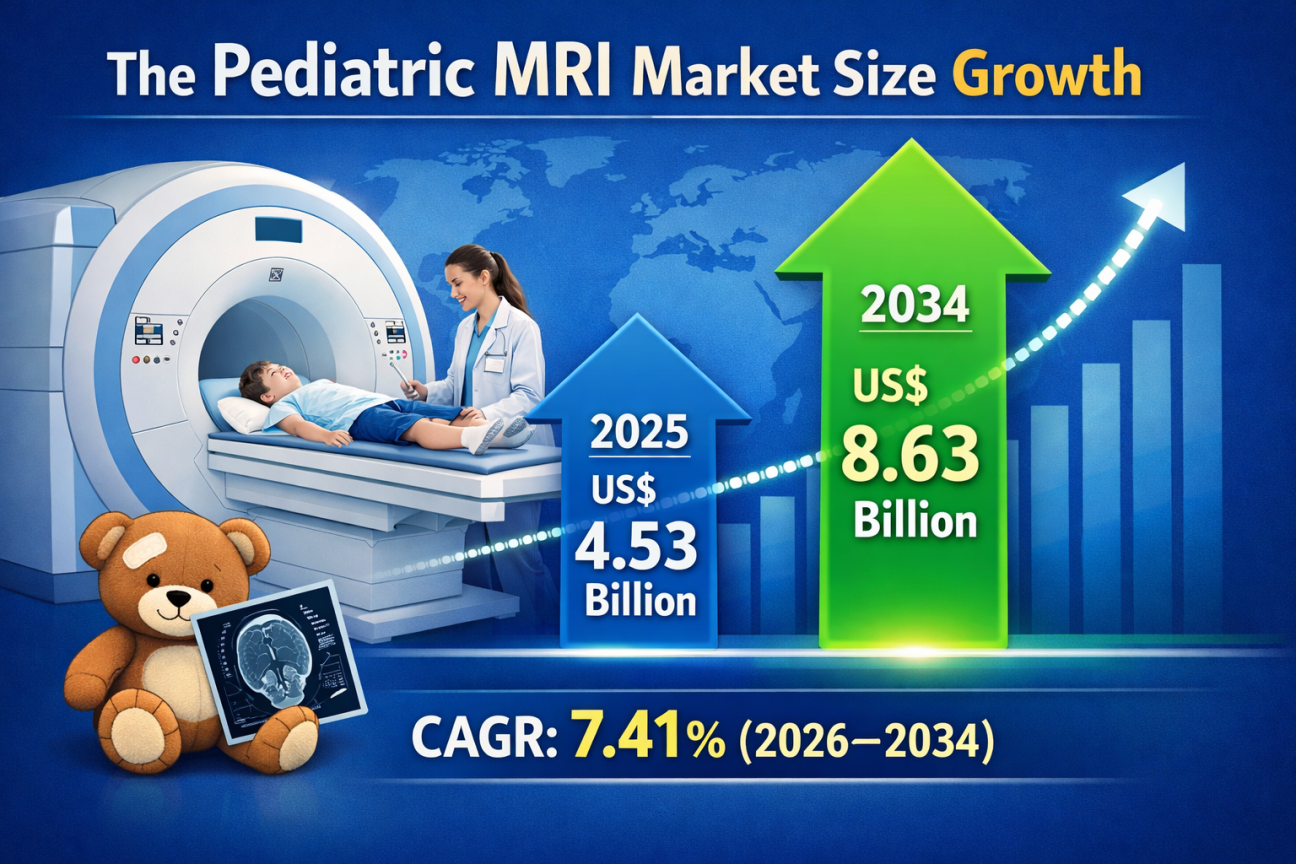
The market is expected to reach US$ 8.63 billion by 2034.
3. What is the CAGR of the pediatric MRI market during 2026–2034?
The market is anticipated to grow at a CAGR of 7.41% during the forecast period.
4. Which segment dominates the pediatric MRI market?
The neurology application segment holds the largest market share due to the high prevalence of brain-related disorders in children.
5. Which region is expected to grow the fastest?
Asia-Pacific is expected to witness the fastest growth due to expanding healthcare infrastructure and increasing diagnostic awareness.
Related Report:
1) Circulating Tumor Cell (CTC) Diagnostics Market Trends and Future Insights (2026-2034)
About Us: -
The Insight Partners is a one-stop industry research provider of actionable intelligence. We help our clients in getting solutions to their research requirements through our syndicated and consulting research services. We specialize in industries such as Semiconductor and Electronics, Aerospace and Defense, Automotive and Transportation, Biotechnology, Healthcare IT, Manufacturing and Construction, Medical Devices, Technology, Media and Telecommunications, Chemicals and Materials.
Also Available in : Korean German Japanese French Chinese Italian Spanish
